
Latest updates from CHNV
——Metallurgical Practice of Hanwei High-Activity Calcium Hydroxide Composite Flux Steelmaking textbooks repeatedly warn that quicklime contains about 24% structural water, which decomposes and absorbs heat in the furnace, and is "not suitable for slag making." Hanwei Technology, however, is going against the grain—it is precisely this "structural water" that holds the key to fast slag production, low energy consumption, and low fluorite content in converters.
Lime is the primary slag-forming material in converter steelmaking, consuming 30-50 kg per ton of steel. The optimal dephosphorization and desulfurization effect is achieved when the slag basicity (CaO/SiO₂) is controlled between 2.5 and 3.5. However, the quality of quicklime supply remains a persistent nightmare for steel mills: Firstly, activity dispersion—unburnt lime continues to decompose and absorb heat from the molten pool upon entering the furnace, while overburnt lime has coarse crystals and dissolves slowly, resulting in significant fluctuations in activity between 250 and 360 mL, consequently affecting the final phosphorus and sulfur concentration. Secondly, inactivation during storage and transportation—lime is highly hygroscopic, and its activity can decrease by more than 30% after three months of storage. Thirdly, after entering the furnace, lime particles are coated with a dense 2CaO·SiO₂ shell, hindering dissolution, while the traditional solution of using fluorite (CaF₂) faces increasingly stringent control over fluorine-containing slag.
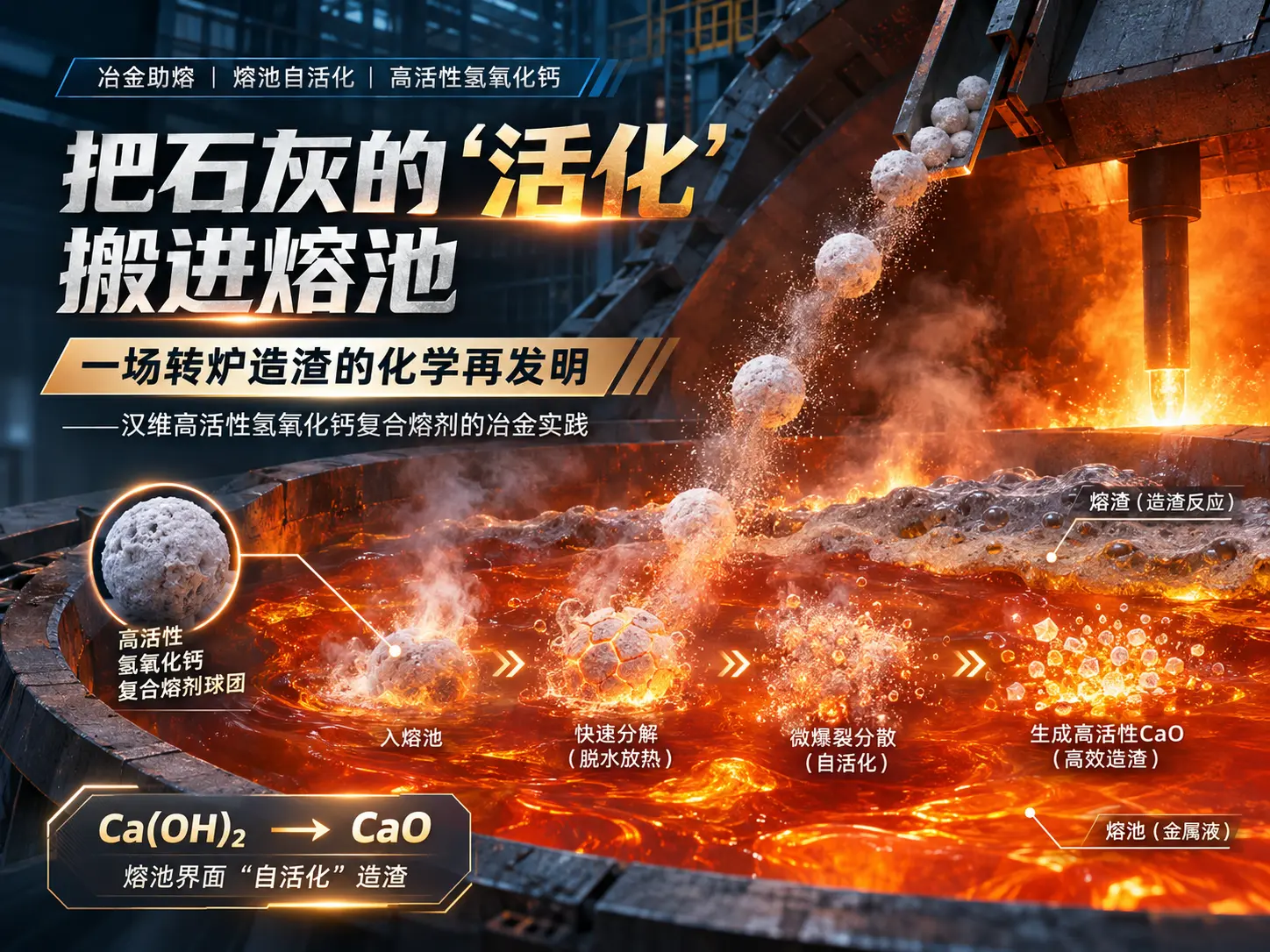
Hanwei Technology uses FM100 high-purity calcium hydroxide (Ca(OH)₂ (dry basis) ≥97.0%, S≤0.02%, P≤0.01%, SiO₂≤0.5%) as the main component, and presses composite iron oxide scale and lightly calcined bauxite into flux pellets with a diameter of Φ1530 mm. When the pellets are heated in the furnace, the calcium hydroxide undergoes a steep dehydroxylation reaction in the range of about 520600 ℃, generating "new CaO" with high lattice distortion, well-developed pore structure and extremely high chemical potential in situ. The dehydration volume effect simultaneously induces micro-explosion self-dispersion, instantly amplifying the slag-gold reaction interface - equivalent to transferring the calcination activation of lime from the mine kiln to the molten pool interface and completing it instantaneously: there is no over-calcination or storage deactivation, because "activation" and "use" occur in the same second.
| 120 t converter industrial test indicators | Conventional quicklime | Hanwei composite flux (replaces 40%) | benefit |
|---|---|---|---|
| Total flux consumption per unit (kg/t steel) | 45.0 | 38.5 | -14% |
| Dephosphorization rate (%) | 78 | 88 | +10 pct |
| Endpoint P (%) | 0.018 | 0.011 | -39% |
| Slag formation advance (min) | — | 1.8 | Shorten smelting cycle |
| Fluorite consumption per unit of steel (kg/t) | 4.1 | 1.5 | -63% |
A 63% reduction in fluorite consumption means a simultaneous decrease in both the fluorine content in the slag and the cost of disposing of fluorine-containing slag—in the current climate of increasingly stringent emission controls, this figure is as valuable as the dephosphorization rate itself. For electric arc furnace short-process and hot metal pretreatment procedures, high-purity calcium hydroxide-based powder also provides a stable and highly active calcium source option.
四、Three honest words for steel mills
First, activity is no longer a mystery: the activity of calcium hydroxide is locked at the factory and will not decrease after six months of storage and transportation at room temperature. Second, alkalinity control is more manageable: the high calcium content of 98% ensures that every kilogram of flux is used efficiently, significantly reducing ineffective slag. Third, fluorite has a fallback option: the alumina-based slag modifier provides a ready-made alternative for reducing fluorine-containing slag. The product is tested according to HG/T 4120-2024 "Industrial Calcium Hydroxide" and the ASTM C110 system, and a full test report is provided with the shipment.
About Hanwei Technology: Hanwei Technology's calcium hydroxide (hydrated lime) is prepared using a controlled hydration process, conforming to the EN 459 system. It offers four models: GH65, FM100, FM300, and FM700, differentiated by purity, whiteness, impurities, and fineness: FM100 Ca(OH)₂ ≥ 98%, whiteness ≥ 96%; FM300 ≥ 96%; FM700 ≥ 95%. Specific details are subject to the model specification table and batch COA. The products are primarily targeted at petroleum refining desulfurization, calcium-based grease thickening, construction bonding, metallurgical fluxing, food acidity adjustment, and sugar, leather, and glass manufacturing applications. We can provide selection and application technical support based on customer's specific working conditions. Samples and complete testing reports are welcome upon request.
References and Basis:
Huang Xihu, Principles of Iron and Steel Metallurgy (4th Edition, Metallurgical Industry Press); Turkdogan E.T. Fundamentals of Steelmaking, The Institute of Materials, 1996; Jiangsu Iron and Steel Industry Association, Requirements for Lime and Related Processes in Steelmaking; HG/T 4120-2024Industrial Calcium Hydroxide.
Note: This article is a product technical promotional piece. The performance data presented are typical application examples and experimental values. Actual results may vary depending on raw materials, formulation, and operating conditions. The production and use of food-grade products must comply with national food safety regulations (including SC production licenses) and standards such as GB 25572-2010 and GB 2760.